Supports
Designed and manufactured in Europe (Germany)
Fast delivery
Customizations available and common
In order to select the most appropriate support system for your optical table or breadboard, it is important to have cleared the requirements of the application:
- Sensibility required in your experiment to environmental vibrations
- Top weight (that is, the approximate weight of the set of components you are going to assembly onto the optical table)
- Spatial distribution on the weight placed onto the table (balanced/not balanced)
- Height
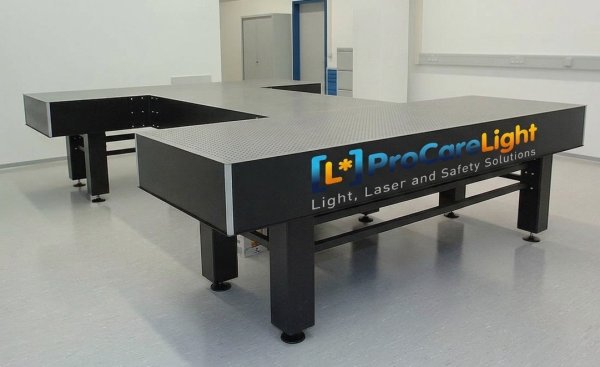
Here is a detailed description of the three support systems for OPTA optical tables, but customizations are available:
- LMT rigid support system (Leveling Mount Table): support system without vibration isolation, that is, a rigid system (the table top is joint inflexible to the support system). Leveling screws which have a characteristic frequency above 10Hz are installed between the table legs and the table feet to compensate for unevenness in the laboratory floor.
There are indicated for those simple applications that do not need essentially isolation level.
- RMT passive support system (Rubber Mount Table): support system with low-frequency vibration isolation, that is, partial vibration isolated table top. The connection between the table top and the support system is realized with reinforced elastomeric shock absorbers (rubbers full of air). Characteristic frequency of these systems lies between 2.5 and 5 Hz, avoiding some kind of vibrations. For compensating the unevenness of the floor, regulating the optical table (according to the weight onto the table) or maintaining this support system re-leveled along the time, it will be necessary to pump the absorbers with a simple bicycle pump. This kind of support system is suitable for standard applications since apart from the partial vibration isolation, RMT support systems offer stability in both horizontal and vertical directions.
- DMT semi-active support system (Diaphragm Mount Table): for this self-leveling table support system, the legs are used as air cambers (air compressed pneumatics and a valve system) and the height and the flatness are automatically recovered. The table is stocked in top of a club-shaped diaphragm mount. Air compressor equipment (external device or a common air compressor line) is needed permanently to work with this system.
Comparison table of legs and support systems for optical tables from Opta - ProCareLight:
|
|
|
|
|
|
|
|
|
|
|
|
|
|
|
|
|
|
|
|
|
|
|
|
When configuring the optical table, it’s important that you tell us your requirements so we can provide the most appropriate quote in terms of surface area, maximum weight capacity, magnetic characteristics, environmental conditions, damping requirements, type of experiments, etc.—and price.
With all this in mind, we’ll do our best to provide you with exactly what you need. If you tell us you want a competitive quote compared to a specific table from a specific manufacturer, we’re off to a bad start… we won’t be able to offer you what you need, and we’ll all be wasting our time.
An additional advantage of PCL's optical tables, breadboards, and supports is that their price is tailored to your needs. They are not low-cost solutions, but we can certainly call them economical optical tables given their value for money.
All products:
- optical tables (tabletops)
- support systems
- optical breadboards
The German manufacturer Opta GmbH, the expert in optical tables, has ProCareLight as its sales partner in Spain and Portugal. At PCL, we are pleased to be Opta's distributors in Spain and Portugal.
More information: ventas@procarelight.com / +34 605 024 420